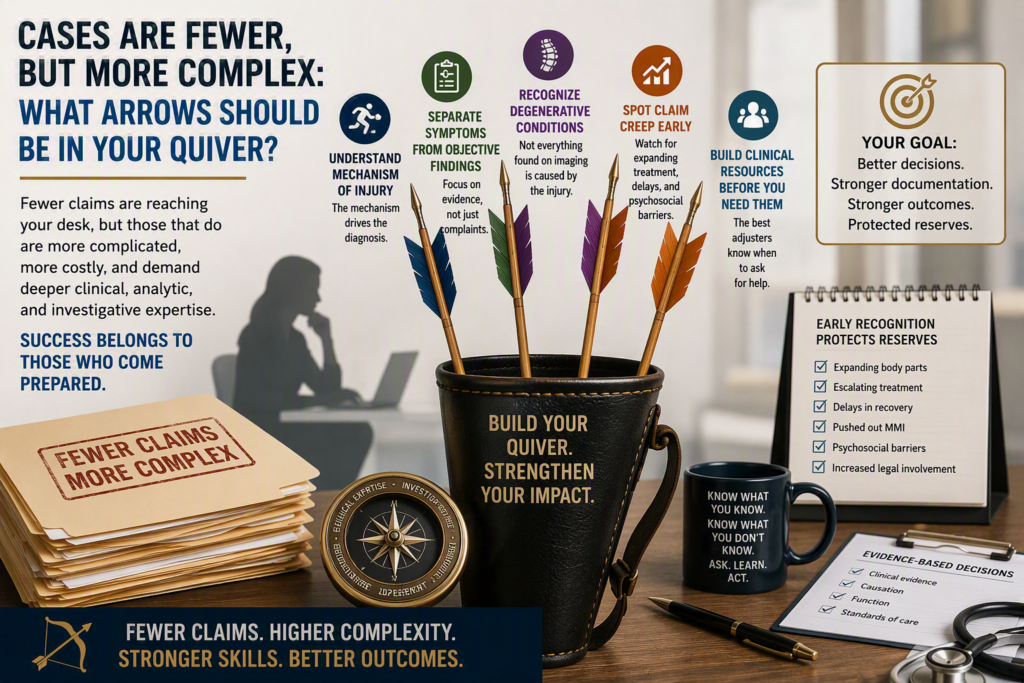

The shift toward higher claim complexity
My journey in the world of Worker’s Compensation began more than 30 years ago. At that time, it was my experience that those handling claim files were able to manage a high-volume of relatively straightforward claims.
However, with the onset of new technologies, advancing medical interventions, automation (and one does not discount AI), as well as significant enhancements in workplace safety, the overall positive effect is that claims are no longer routine. Claim frequency may be declining, but claim complexity continues to increase. The files arriving on today’s adjuster’s desk often involve multiple body parts, competing medical opinions, pre-existing conditions, psychosocial barriers, and treatment recommendations that are difficult to evaluate.
identifying the Drivers of complex claims
Those claims that generate the greatest costs, extended treatment disputes, and place significant pressure on reserves are those files that often require substantially more analytic, clinical, and insightful expertise.
The next question then becomes is whether complexity is becoming the new normal? Followed by what skills should the modern claim file handler have in their respective quiver to address all of these issues?
Mastering the Mechanism of Injury
As I have talked about in the recent past, the first point is that you, as a claim file handler, must have is to fully understand the mechanism of injury like a clinician. How (exactly) did the injury occur? What were the initial complaints? What was initially reported to the EMT or emergency room providers? And what specific objective clinical findings were noted at the time of injury.
Those experienced claim file handlers note there is a significant difference between a lifting injury, a twisting type of event, a fall, repetitive activity or even a motor vehicle collision. Having a clear consistent understanding of the exact mechanism of injury will be a significant component in your quiver, particularly when the diagnosis does not correlate with the facts that you have.
SEPARATING SYMPTOMS FROM CLINICAL EVIDENCE
Our workforce is aging. We all have aches and pains and subjective complaints that are clearly unrelated to the reported mechanism of injury. The second component of your quiver must be an understanding between subjective complaints and objective clinical findings. The next question becomes are treatment recommendations addressing the injury, supported by the clinical evidence presented or are they addressing the symptoms provided by the injured individual that do not appear to be a function of the mechanism of injury identified.
A key takeaway is that those claim file handlers who can distinguish symptoms from objective findings make stronger claims determinations and are able to document those decisions in a more efficacious manner.
HOW TO COMBAT CLAIM CREEP
The third component is the ability to recognize degenerative conditions before they are assumed to be part of the compensable injury. Simple discovery of additional pathology does not equate to being a sequela of the compensable event. This is why the age demographic means so much, understanding that the human machine does in fact wear out, and the more common areas include the cervical and lumbar spine, the bilateral knees, and bilateral shoulders. Simple recognition of pathology does not mean it is a function of the event that occurred several weeks previous. It has been my experience that the more expensive claims drift because no one inquired if the treated condition pre-existed the date of injury or not.
Understand that private group health insurance is particularly expensive. This is not to say that we do not have health issues, only that when the body parts identified as part of the compensable injury expand, or there is escalating treatment without clear improvement, the expected dates of maximum medical improvement continued to be pushed back, and there is objectification of increasing psychosocial barriers to recovery; indicate that “claim creep” must be considered. Early recognition of these facts allows for appropriate intervention and protection of the reserves established.
BUILD YOUR NETWORK OF CLINICAL EXPERTISE
Before you can fill your quiver with arrows, you need to build those arrows. Have those clinical resources available to you long prior to when you need them. The more successful claim file handlers know when to ask for help. As a PA, my tenet is you have to know what you know, and more importantly know what you do not know. Never hesitate to ask for help or seek guidance when a problem isn’t resolving. Have in your contact list appropriate clinical consultants, peer reviewers, case managers and other educational resources enabling you to complete your tasks as expeditiously and efficiently as possible. There is no sole source to answer all your needs. This further augments your need to maintain a comprehensive contact list.
THE FUTURE OF CLAIMS HANDLING
In summary, there may be fewer claims to be addressed, however each of those files reaching your desk most probably demands a broader explanation and understanding of medicine, causation, function and applying the standards of evidence-based medicine. Technology can help this process, but it is not the sole solution. Education is key at every level of the game. Those claim file professionals who will thrive in the next decade will be those who have the most useful arrows in their quiver.
Five Questions for Every Complex File
- Does the diagnosis fit the mechanism of injury?
- What objective findings support the diagnosis?
- Are the imaging findings acute or degenerative?
- Is treatment improving function?
- Have I involved the right clinical resources?